Last Updated on December 3, 2025
Comfrey (Symphytum spp.) has a long history of use in animal husbandry, as well as folk medicine, and is cherished for its high nutrient content and ability to aid the repair of skin and bones.
Indeed, comfrey is a source of an impressive array of nutrients, including thiamine, riboflavin, nicotinic acid, pantothenic acid, vitamin B12, vitamin C, vitamin E, iron, manganese, calcium, and phosphorus. It also contains allantoin, a chemical compound which promotes the healing of tissues, as well as soothing mucilage.
Traditional Uses of Comfrey
There are numerous sources that recommend the internal use of comfrey for both humans and animals, because of the benefits I just mentioned.
In her classic herbal, The Complete Herbal Handbook for Farm and Stable, Juliette de Baïracli Levy recommends using the root and leaves for internal hemorrhages, broken bone, pulmonary problems, and arthritis. She details how to make drench, an internal remedy, with comfrey. She says, “English gypsies say that a handful of comfrey roots, cleaned and fed daily to horses and cows in the spring, will rid them of all winter torpor and put them into fine bloom in one week.”
The book, Chicken Tractor: The Permaculture Guide to Happy Hens and Healthy Soil, also recommends using comfrey as fodder. Andy Lee & Pat Foreman say, “It is a favored herb for poultry, goats, sheep, and pigs, with cows being only moderately interested, and horses being only slightly interested in it.”
Like de Baïracli Levy, Lee, Foreman, and countless other farmers, homesteaders, and pet owners, I’ve been feeding comfrey to my animals for years. And in my earlier days as an herbalist, per the advice of many of my cherished classic herbal books, I would drink cups of comfrey tea myself.
Comfrey Toxicity Concerns
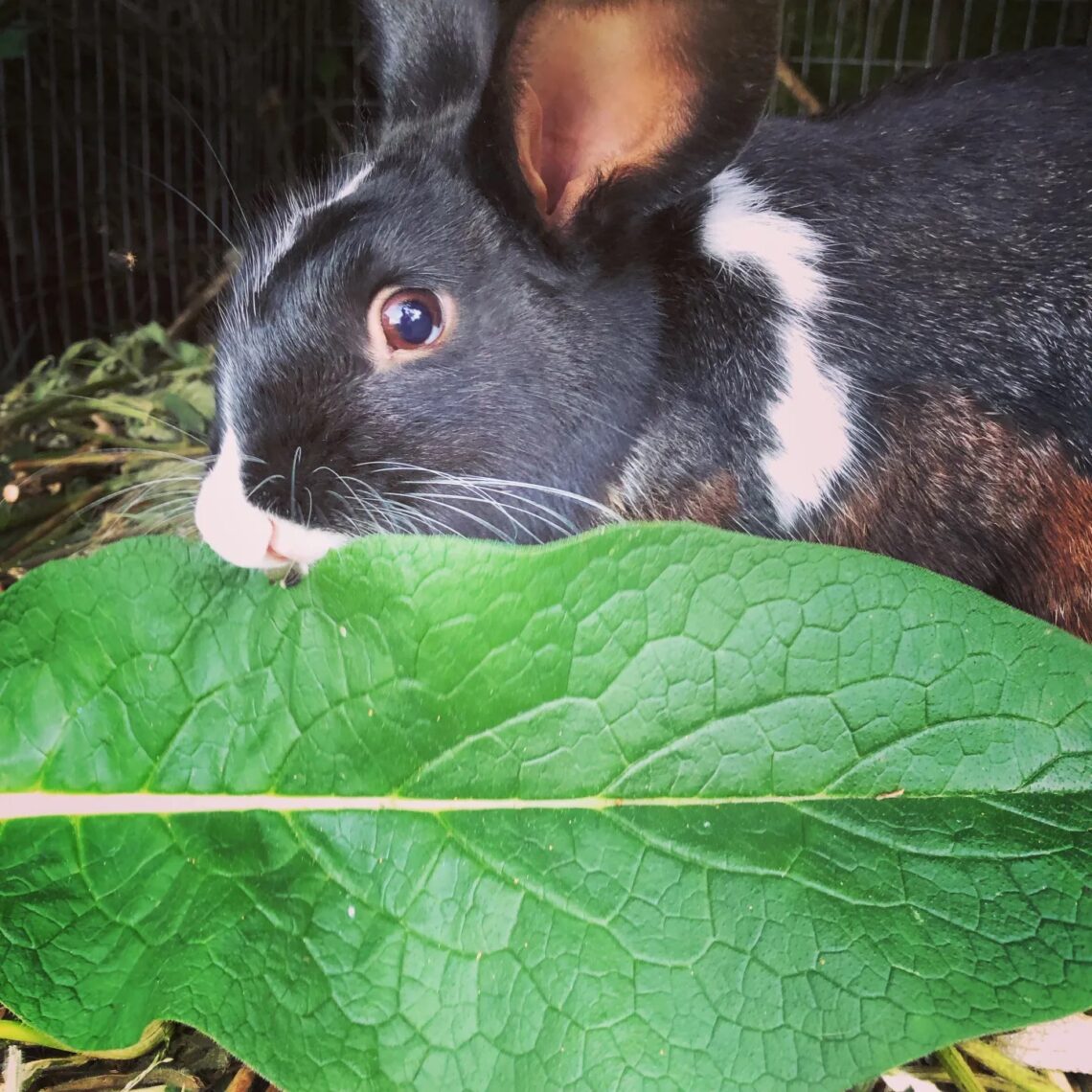
In more recent years, hearing about the toxicity concerns with internal use of comfrey has caused me to shy away from consuming the herb. But, I do still give our chickens a few fresh leaves every so often and for awhile they were escaping daily (thanks to our naughty dogs who were putting holes in their fence) and did a number on a nearby comfrey plant, eating the lush leaves every chance they got. I also give a few fresh leaves of comfrey to my rabbits here and there because they seem to really enjoy it.
Recently, I began to wonder if I should be feeding comfrey to my animals because of these toxicity concerns. So, I decided to do a deep dive into the scientific research and find out more about the safety of consuming this herb.
Is Comfrey Toxic for Humans and Animals?
Modern scientific research has found that comfrey contains pyrrolizidine alkaloids (PAs), a group of plant toxins that affects both humans and animals, and are said to have some pretty serious side effects with large or long-term exposure, including acute liver failure, cancer, and even death.
This isn’t news. We’ve known that comfrey contains PAs since the 1960’s. But, exactly how toxic the particular alkaloids that occur in comfrey truly are when consumed by humans and other mammals is still up for debate.
PA levels in comfrey vary depending on both the plant part and the species. Roots generally contain higher concentrations of PAs than mature leaves, making them potentially more toxic. Additionally, different comfrey species differ in toxicity: for example, Russian comfrey (S. × uplandicum) and prickly comfrey (S. asperum) contain more PAs, including higher levels of toxic constituents than true comfrey (S. officinale) (Gardner & McGuffin, 2013).
Is It Safe for Animals to Eat Comfrey?
The MSD Veterinary Manual does not mention comfrey among the plants most likely to cause pyrrolizidine alkaloidosis, or PA poisoning, which often leads to liver failure and death. Instead, it lists ragwort (Senecio jacobea), groundsel (S. riddellii, S. longilobus), rattleweed (Crotalaria retusa), and seeds of yellow tarweed (Amsinckiaintermedia) as the plants that most commonly cause this condition (Bildfell, 2022).
It’s also worth noting that animal species have different tolerance to PAs. The MSD Veterinary Manual states that “individual susceptibility varies greatly within species; young growing animals are most susceptible” (Bildfell, 2022).
Can goats and sheep eat comfrey?
Goats and sheep are considered fairly resistant to PAs, but they are susceptible to acute toxicity at a high enough dose (Maia et al., 2013). According to the MSD Veterinary Manual “sheep and goats require ~20 times more plant material than cattle before a fatal poisoning develops.” (Bildfell, 2022).
A 2022 study found that “rumen metabolism can be considered a detoxification step,” which explains why ruminants may have a higher tolerance to certain PAs (Taenzer et al., 2022).
Is Eating Comfrey Safe for Other Animals?
Rabbits appear to absorb only small amounts of pyrrolizidine alkaloids (PAs) when they consume comfrey (Pierson et al., 1977). Other animals, however, vary in their susceptibility: cattle, horses, farmed deer, and pigs are considered the most vulnerable to PA-related toxicity, according to the MSD Veterinary Manual (Bildfell, 2022).
PA Transfer to Animal Products
Livestock being poisoned by PAs is certainly not ideal. But, I also wondered if animals consuming PAs would have an effect on their eggs, meat, and milk. Research has found that this is indeed the case. Note: the following studies I’m going to mention were not involving comfrey, but rather other plants that also contain PAs.
A study examining the amount of PAs in the eggs and meat of chickens who were fed a diet containing plants that are known to have high levels of toxic alkaloids found that they were transferred to the eggs, particularly the yolks. “Overall transfer rates for the sum of PAs were estimated between 0.02% and 0.23%, depending on the type of PAs in the feed,” states Mulder, et al. (2016)
The study found that PAs were also transferred to meat. Animals butchered shortly after being fed PA rich herbs had levels of PAs slightly lower than the eggs, with levels somewhat higher in the livers.
When the chickens in the study were switched to a diet without PAs, the levels of the alkaloids in the eggs and meat did decrease gradually. But, eggs and meat from hens exposed to the higher levels of PAs still contained amounts “above detection limits” 14 days later (Mulder et al., 2016).
PAs also are transferred to the milk of lactating mammals that consume food containing these toxins. There have been cases of human babies developing severe liver damage because of exposure to PAs in their mother’s milk (Wiedenfeld, 2014).
Do the PAs in Comfrey Transfer to Animal Products?
While it does seem that PAs can be transferred in animal products, research specific to comfrey has actually been encouraging in this regard. In one study, young broiler chickens fed a diet that was supplemented with 4% dried comfrey leaves did not have detectable levels of PAs in liver and breast muscle at the end of a month (Oster et al., 2020).
Similarly, piglets in another study whose diet was supplemented with 15% dried comfrey leaves did not have any abnormalities, despite this relatively high consumption of PAs. It’s also interesting to note that the comfrey supplementation promoted a significantly more diverse gut microbiota in the pigs (Oster et al., 2021).
Some studies even show benefits to giving animals comfrey. One study showed that comfrey juice was an effective nutritional supplement for helping broiler chicks gain weight (Esiegwu & Obih, 2021). Another found that supplementing the diet of laying hens with comfrey polysaccharides increased overall egg production and egg mass (Zhou et al., 2022).
Should You Feed Animals Comfrey?
Comfrey’s long history of folk use contrasts with modern scientific findings, which raise safety concerns, especially with long-term use or high doses. Feeding comfrey to animals is nuanced: it contains potentially toxic alkaloids, but is also rich in nutrients and other beneficial compounds. Ultimately, whether you feel comfortable feeding it to your animals is up to you, but understanding the science can help you make a more informed decision.
References
Cheeke, P. R. (1979). Update on comfrey. Oregon State University Rabbit Research Center Newsletter. Oregon State University. https://watchbird-ojs-tamu.tdl.org/watchbird/article/download/1996/1967
Hooper, P.T. (1978). Pyrrolizidine Alkaloid Poisoning Pathology with Particular Reference to Differences in Animal and Plant Species. Effects of Poisonous Plants on Livestock. Academic Press, 161-176. https://www.sciencedirect.com/science/article/pii/B9780124032507500224
Esiegwu, A.C., and Obih, T.K.O. (2021). Growth performance, haematological and serum biochemical indices of broiler starter chickens offered dietary supplement of comfrey leaves extract. Journal of Agriculture and Food Sciences, 19(1). https://www.ajol.info/index.php/jafs/article/view/210896
Gardner, Z., & McGuffin, M. (Eds.). (2013). American Herbal Products Association’s botanical safety handbook (2nd ed.). New York: CRC Press.
Ibanez, G. (2005). Pyrrolizidine Alkaloids. Encyclopedia of Toxicology, 2nd edition, 585-587. https://doi.org/10.1016/B0-12-369400-0/00822-X
Maia, L.A., de Lucena, R.B., Nobre, V.M.T., Dantas, A.F.M., Colegate, S.M., and Riet-Correa, F. (2013). Natural and experimental poisoning of goats with the pyrrolizidine alkaloid–producing plant Crotalaria retusa L. Journal of Veterinary Diagnostic Investigation, 25(5) 592–595. DOI: 10.1177/1040638713495544. https://journals.sagepub.com/doi/pdf/10.1177/1040638713495544
Mattocks, A.R. (1980). Comfrey: Toxicity and uses. The Lancet.
Mulder, P.J., de Witte, S.L., Stoopen, G.M., van der Meulen, J., van Wikselaar, P.G., Gruys, E., Groot, M.J., and Hoogenboom, R.L.A.P. (2016) Transfer of pyrrolizidine alkaloids from various herbs to eggs and meat in laying hens,Food Additives & Contaminants: Part A, 33:12, 1826-1839, DOI: 10.1080/19440049.2016.1241430
Oster, M., Reyer, H., Keiler, J., Ball, E., Mulvenna, C., Ponsuksili, S., and Wimmers, K. (2021). Comfrey (Symphytumspp.) as a feed supplement in pig nutrition contributes to regional resource cycles. The Science of the Total Environment. https://www.ncbi.nlm.nih.gov/pmc/articles/PMC8463835/#__ffn_sectitle
Pierson, M. L., Cheeke, P. R., & Dickinson, E. O. (1977). Resistance of the rabbit to dietary pyrrolizidine (Senecio) alkaloid. Research communications in chemical pathology and pharmacology, 16(3), 561–564. https://pubmed.ncbi.nlm.nih.gov/847303/
Rode, D. (2002). Comfrey Toxicity Revisited. Trends in Pharmacological Sciences, 23(11), 497-499. https://eclecticschoolofherbalmedicine.com/wp-content/uploads/2016/07/Comfrey-Toxicity-Revisted-Rhode.pdf
Pyrrolizidine alkaloids, Meyler’s Side Effects of Drugs (Sixteenth Edition). (2016). Editor(s): J.K. Aronson, Elsevier,
Pages 1069-1072, https://doi.org/10.1016/B978-0-444-53717-1.01373-1.
Wiedenfeld, H. (2014) Pyrrolizidine Alkaloids. Encyclopedia of Toxicology (Third Edition), Academic Press,
Editor(s): Philip Wexler,
Pages 1170-1174,
ISBN 9780123864550,
https://doi.org/10.1016/B978-0-12-386454-3.00054-3.
(https://www.sciencedirect.com/science/article/pii/B9780123864543000543)
Zhou, H., Guo, Y., Liu, Z., Wu, H., Zhao, J., Cao, Z., Zhang, H., & Shang, H. (2022). Comfrey polysaccharides modulate the gut microbiota and its metabolites SCFAs and affect the production performance of laying hens. International journal of biological macromolecules, 215, 45–56. https://doi.org/10.1016/j.ijbiomac.2022.06.075